
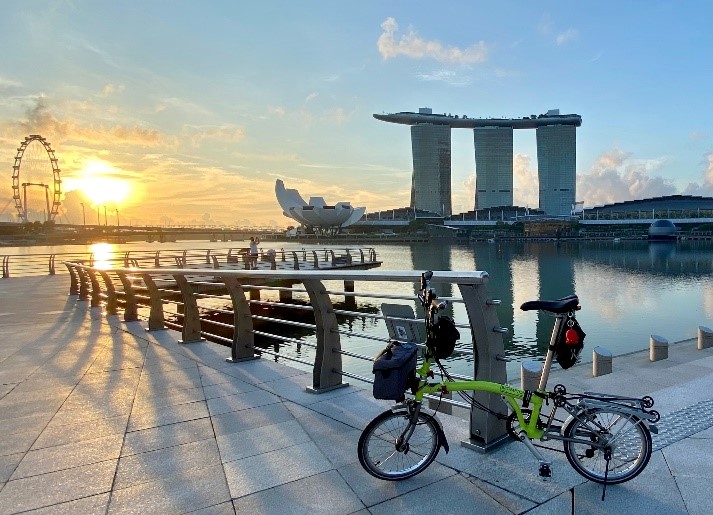
On 11 June 2020, the Court of Justice of the European Union answered a request for a preliminary ruling brought by the Enterprise Court of Liège, Belgium. The judgment is good news for manufacturers and designers since it confirms that accumulation of intellectual property rights may arise provided that the specific eligibility requirements for each right are met. The decision was reached in a dispute between Brompton, the company behind the well-known Brompton folding bicycle, and the company Get2Get, which sells a visually very similar bicycle in Belgium.
The shape of the Brompton bicycle was formerly protected by a patent which has now expired, patent protection being limited to 20 years starting from the patent application. Brompton therefore claimed that the Get2Get bicycle infringed its copyrights. Get2Get, however, contended that the appearance of the bicycle is dictated by the technical solution sought, i.e. to ensure that the bicycle can fold into three different positions, and that in those circumstances copyright protection does not apply, only patent protection. The Enterprise Court of Liège therefore asked the Court of Justice whether copyright protection also applies to a product the shape of which is, at least in part, necessary to obtain a technical result (in this case, being the folding ability of the bicycle).
To answer the question, the Court of Justice first recalled the two conditions for a “work” to be protected under copyright law: (i) it has to entail an original subject matter which is the author’s own intellectual creation and (ii) it requires the expression of a creation (objectivation of an idea). According to the Court’s settled case law relating to the first condition, no copyright protection can be granted “if the realisation of a subject matter has been dictated by technical considerations, rules or other constraints which have left no room for creative freedom or room so limited that the idea and its expression become indissociable”. The underlying principle is that granting copyright protection in those circumstances would result in a monopolisation of an idea (since the different methods of implementing the idea are so limited that the idea and the expression of the idea become indissociable), which would be detrimental to technical progress and industrial development.
In its ruling, the Court of Justice clarifies “that a subject matter satisfying the condition of originality may be eligible for copyright protection, even if its realisation has been dictated by technical considerations, provided that its being so dictated has not prevented the author from reflecting his personality in that subject matter, as an expression of free and creative choices”. Where a product the shape of which is, at least in part, necessary to obtain a technical result but not exclusively dictated by this technical result, the national court therefore has to verify whether the author, through that shape, has expressed his creative ability in an original manner by making free and creative choices in such a way that that shape reflects his personality. If so, copyright protection may be granted. The national court has to take account of all the relevant aspects of the case as they existed when the subject matter was designed, irrespective of the factors external to and subsequent to the creation of the product (e.g. protection under other IP rights). The fact that other possible shapes exist which can achieve the same technical result makes it possible to establish that there is a possibility of choice, but is not decisive in assessing the factors which influenced the choice made by the creator.
In its ruling, the Court of Justice again adopted a positive position towards accumulation of intellectual property rights, as it did previously in the Cofemel decision. Regardless of any protection under other IP rights, copyright protection can be granted to a product if the relevant conditions for copyright protection are fulfilled. The Enterprise Court of Liège now faces the task of determining whether the Brompton folding bicycle qualifies as a “work” in the meaning of copyright law. For this, the court has to verify whether the bicycle’s shape is exclusively dictated by technical considerations, rules or other constraints, or whether its author, despite the fact that the shape of the bicycle is necessary to obtain a certain technical result, through that shape was able to express his creative ability in an original manner by making free and creative choices.
Please contact Karel Janssens for further information about this case and/or for general legal advice relating to intellectual property.